Thursday, 30 April 2009

Behind the Veil


The photo above is of an Orthodox chalice veil. This is used to cover the gifts, but the actual coverings placed over the vessels in the Great Entrance are usually shaped like a cross, so that the bars of the cross hang down at four sides. The Great Entrance takes place after the gifts have been prepared. The clergy carrying the gifts emerge from the door to the right of the Holy Table (their right) and come into the church singing. They then walk round to the centre of the Iconastasis and enter the Holy Doors, placing the gifts on the Altar or Holy Table. The gifts, even now, represent Christ, that is, Christ before the Crucifixion. The coverings represent His clothes which are taken from Him before He is laid on the Cross.

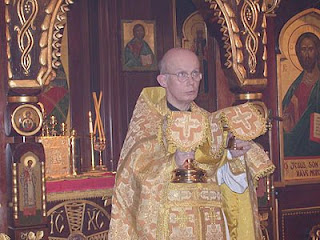

When the gifts are brought into the body of the church, the congregation shows reverence. Even before the consecration these things are taken to be holy and as representing the Saviour.


In the West, we hardly show any reverence towards the unconsecrated elements, but in the Old Rite, the veils are important, and even before the Offertory itself, the gifts are veiled and treated with respect. We need to recognise that as soon as the bread and wine (and water) are placed on the credence table - and when the priest's host is brought in procession by the priest at the beginning of the Mass - they are, to some extent, "holy" and deserving of respect; they have already been set aside for God and therefore belong to Him. In the Ordinary Rite, we need to consider how to express something of this. We might consider how the gifts are brought up in procession. At the same time, there is need to consider the Sacred Vessels which really should not be used in the offertory procession. Sometimes the elements are consecrated in unworthy vessels (even straw baskets!). The Vatican has made it clear - more than once - that only "unbreakable", worthy vessels are to be used. However beautifully made, ceramic chalices and patens are forbidden - because they break. At the same time, there is much to be said for retaining the use of gold-inlaid vessels because this refers back to the Holy of Holies (the "Golden Room") and the Ark of the Covenant.


By reverencing the offertory gifts in some way (for example by incensing them) we are pointing to the fact that everything offered to God, and accepted by Him, is holy and precious. This includes ourselves. Showing reverence in the Liturgy - to each other as well as to the gifts - may help us to remember that we owe each other respect as sons and daughters of God and that we owe respect to the whole of God's Creation. Ritual is not empty unless we misuse it, abuse it, misread it or misapply it. Those who want to celebrate the Liturgy in a penny-pinching or demeaning way do disservice to themselves as well as to their Creator.


You see, veiling has much to commend it, since it speaks to us of holiness and Mystery.

Tuesday, 28 April 2009

Without Veil


The recent Ushaw conference on the celebration of the 1962 Latin Rite set me off thinking again about veils. Some years ago - before I was even interested in the 1962 Rite - I became convinced that I should use the chalice veil for Mass, and veil the tabernacle. At the time I couldn't have put this conviction into words; it was almost a gut reaction. Thinking back on it, I remember that part of the background to this was my disappointment over some modern churches. Some of them are almost clinical in their architecture and decoration. I am thinking of one in particular which seems to be all metal, corners and hard surfaces. One of the thoughts that occurred to me at the time is that when a few insistent voices are being raised about the possibility of women priests and the need for greater recognition of the place of women in the Church (how could we not notice them? Where would our daily Mass attendance be without them?) Bishops, Apostolic Vicars and architects are making our church buildings look even more masculine. There's no sense in it!
But it's not only that; there is something missing in a church or liturgy without veils, fabrics and, or, curtains. I know that in some churches even chasubles are left in the sacristy press (unless the Bishop comes!).
Why does everything have to be hard, sharp and bland in so many modern churches? I have often puzzled over this. Has it something to do with a desire to distance ourselves from the exuberance, or even triumphalism, of the past? Why is colour no longer thought tasteful? Why did ornament disappear? What strange authority decided that "noble simplicity" meant colourless? I know about architecture's obsession with light. I can appreciate a well-lit building, and there's nothing so atmospheric as a church interior dressed in daylight. But why do we have to be so penny-pinching and -well, bland?
Back to the veil. At the offertory of the Tridentine Solemn High Mass, the Sub-Deacon takes the veiled chalice and paten to the celebrant using a humeral veil. After the host has been placed on the corporal, the Sub-deacon takes the paten from the Deacon and holds it beneath the humeral veil whilst standing behind the Deacon and the Celebrant. Why does he do this? When I saw it, I instinctively connected it with the Orthodox use of veils and the "great veil" itself - the Iconostasis. There is something in this, but we also need to remember that not too long ago, the chalice, paten and other Eucharistic vessels were considered "sacred" because of what they held. These things were not to be touched by anyone and everyone (as it seems there are today in most places). It is interesting that in some places in the Western Church there is a return to reverence for holy things, and not just because of the celebration of the Old Rite. The fact is that some people in the Catholic Church are "thirsty" for the sacred and they are beginning to show reverence wherever they think it is appropriate. This may be part of the reason for the growing interest in the Old Rite.
Of course, the veiling is not just about the sacredness of the vessels themselves. Looking at the antiquity of the Byzantine Rite it seems obvious that the practice of veiling in order to reveal something of the "mystery" began in the earliest years of Christianity. Perhaps something was adapted from pagan practices, but we can never forget the ceremony and ornaments of the Jerusalem Temple and, before that, the Tabernacle in the desert. Without doubt, the early Liturgy borrowed elements from the Jewish practices, and these should not be despised today when our increasingly secular and pagan world is dying for lack of the sacred.
Why should it be thought that everything in the Liturgy has to be seen and heard? In recent years the Holy See has reminded us of the need for silence in the Liturgy. Not only that, but the modern Rite is too "wordy" whereas its ceremony leaves much to be desired. It is as though we have finally succumbed to the intellectualism of the Enlightenment and forgotten the importance of gesture and ritual. it seems almost laughable that there has been an attempt to introduce dance into the Liturgy whilst, at the same time, the "dance" of the Solemn High Mass has been removed.
Veiling says something about the importance of not seeing. In the Old Rite, the vestments themselves act as veils because the priest or bishop has his back to the people because he is eastwards-facing. Some things are hidden from sight. This is obviously an early development and is still continued in the Orthodox Liturgy. It became clear to me whilst looking at the actions of the Solemn High Mass that the Roman Rite contained its own "iconastasis". Not only are certain things hidden from sight, but some things are not heard. Does this mean that people in the pews are deprived? From what I have seen recently - and that includes hearing the opinions of people who have attended the Old Rite Liturgy - any deprivation they suffer is because of the way the Ordinary Rite is sometimes celebrated, and because so many in our churches do not know how to use silence.
There are so many other things to say, but I will leave the matter here for now. I would just like to say again that Western Christians have much to learn form their brothers and sisters in the "East", and perhaps, looking at the Old Rite, we have much to learn from what has gone before. It is surely part of the Holy Father's intention in the Moto Proprio that we should be open to these things.

Saturday, 25 April 2009

Learning from the Past


I came home from the Ushaw conference last Thursday and I am still recovering. Because most of us priests there were celebrating the Extraordinary Rite we had to be up early to say Mass. I was booked for 6.30 am and so (because everything is moving slower for me these days) I had to be out of bed by 5.15 at the latest.
I am still thinking about some things I heard and saw on the conference, and there is one area in particular that I find fascinating because it links up with the Orthodox liturgy and with the Church of antiquity. This is what I could call "veiling". I am thinking of the Great Entrance in the Orthodox Liturgy, the use of the humeral veil in the 1962 Solemn High Mass and the tradition we have (or had) in the Catholic Church of veiling tabernacles and covering the sacred vessels before and after Mass. There is something here to examine and think about because it speaks of mystery in relation to the Eucharist. many Catholics, and some Christians of other denominations seem to have an instinct for the sacred. This leads to comments about the vernacular Ordinary Rite lacking "mystery" and to the adoption - especially in non-Catholic communities-of the kind of ritual that would have been unthinkable a hundred years ago.
More later.

Monday, 13 April 2009

Absent for a While


I shall be absent for a while, being in Wales for three days this week, then taken up with Divine Mercy Sunday - then, in Low Week being at Ushaw College to brush up my Latin and my celebration of the 1962 Latin Mass. In the meantime, here is an extraordinary picture. You can follow it up by logging on to tlig.org. it is a picture of Vassula giving a talk in Los Angeles, but I think you will agree that there are two people in this picture, and the one at the front has a familiar shape!
I know the young lady who took the photo. I can assure you there is no trick involved. Some people who know about cameras were consulted - they had no explanation. There was no fault with the camera. Another point was that three people (at least) have testified that they saw "someone" in front of Vassula. Intriguing no?
Back soon.

Saturday, 11 April 2009

Happy Easter (almost)


For me, Easter will always be incomplete until I can share it with my brothers and sisters in the Eastern Orthodox Churches. So, I wish anyone who reads this a very happy Easter, and I will do it again on and after April 19!
This evening at the Vigil, the music was not a great success. My organist bravely attempted to sing the psalms and it didn't quite come off! I managed the Exsultet quite well, but when it came to the blessing of the water and the font, I decided to sing the blessing. I started off in the wrong key which soon became a minor key! I tried to correct it as I went along, but it got weirder and weirder until it seemed to me that I was singing an Orthodox chant - so, I "went with it" as they say and thought about Christian Unity! The water was blessed, and the congregation didn't bat an eyelid.

Thursday, 9 April 2009

Twelve at the Table


The number twelve is so important in Holy Scripture that it would be extraordinary if the number present at the Last Supper with Jesus was more or less. In Hebrew tradition the number signifies the "perfection of government" so that it has something to do with "rule" or authority.


We know that the number twelve signified the whole of Israel (twelve tribes) and therefore represents the whole people. In the Apostles we therefore have a sign of the Kingdom and of the Church, ultimately encompassing everyone. This suggests to me that the Last Supper was only for Jesus and the Apostles. This has nothing to do with "fairness" or some imagined slight against women. The significance of the Twelve relates to the Patriarchs (all men) and because of the identification of the one man Israel with the whole people, and the fact that "all are seen in the head" the significance of the Twelve includes all, both men and women. The apparent lack of the physical presence of Our Lady or Mary Magdalene does not mean that they were not "present" in some other way - as members of the One Body or as "Daughters of Israel", being represented, in this case, by Jesus with the Twelve.


This opens up another debate about the priesthood and how the ministerial priesthood is connected with both men and women - but only because priests are male. This needs to be developed with reference to the Book of Genesis 3,16 and to the Gospel of Matthew 20, 24-27 (and other references to Jesus being "servant"). St. Paul understood that as the Second Adam, Jesus incorporates everyone into Himself, but there is a particular way in which the Second Adam must repair the mistake made by the first Adam. Sin came into the world through Adam, and with sin came death. Not only that, but Adam (and his descendants) would be marked or scarred by this sin to the extent that they would be somewhat disfunctional. We can see something of what this means by looking at the way sin affected Eve. In Genesis 3 we hear God saying, "Your desire shall be for your husband, and he shall rule over you". In Matthew 20, Jesus refers back to this when He says;


"You know that the rulers of the Gentiles lord it over them, and their great ones are tyrants over them. It will not be so among you; but whoever wishes to be great among you must be your servant, and whoever wishes to be first among you must be your slave; just as the Son of Man came not to be served but to serve, and to give His life as a ransom for many".


I checked with a Hebrew scholar and it is true that the two phrases found in Genesis and Matthew, which can be expressed as, "lord it over", have the same root. Adam rules Eve and this is a consquence of sin. The inequality between the sexes is a result of Adam and Eve's sin. Christ repairs this by doing the opposite of the first Adam. Christ becomes the servant. The Master is the Servant. Only in this way can reparation be made, and the priesthood established by Christ is the priesthood of the New Adam. This can only be expressed through the male since there must be a relationship between Adam and Eve, Christ and the Church, husband and wife. In a particular way it remains necessary for the ministerial priesthood to be male only. The male (Adam) is a servant, even to the giving up of his life for the female. St. Paul understood this; he speaks of Christ giving up His life for the Church and links this sacrifice with the love a husband should have for his wife.


In all this there is nothing about denigrating women or seeing them as second-class citizens. It is not only unnecessary for women to be ordained, it is unbiblical and distorts our understanding about the work of Salvation. (I leave aside other arguments against women's ordination here, though I may return to them later -there are more than one!).

With all this, we can see that there are very important reasons why the Last Supper was "only" for Jesus and the Apostles. Let's consider the defection of Judas. Before Judas goes out, Jesus is the Head, but not one of the Apostles. After Judas defects, Jesus becomes one of the twelve - the best one; the perfect one. Jesus not only takes the place of Judas, He begins to repair the damage done by Judas by taking upon Himself not only Judas's sin, but the sins of all, and acting as the true disciple Himself, being also the New Adam and the perfect Son of Man and Son of God. Thus His obedience to the Father is perfectly expressed in His willingness to take on Himself all that needs to be done to repair the damage of sin. If Judas had only known that his sin had been taken to the Cross and that Jesus had fulfilled for Judas the vocation he had been given from the beginning. Judas was set free by Christ, but was unable to accept this. Jesus had already shown what it meant to follow Him by washing their feet (including the feet of Judas). He took this lesson in humility and service to its horrendous conclusion, carrying the others with him even though they scattered. They all found themselves once again - in Him.


We can see then, that as Judas left, there were still twelve Apostles at the Table, Jesus now taking upon Himself, the vocation of an Apostle. This is linked to His Priesthood being the source of every priestly ministry. I find my priesthood in His. Without Him I have no priesthood. Jesus, being the perfect Hight Priest is also His own perfect disciple, being true to Himself, a Servant of the Truth and a perfect Son of the Father.

After the Resurrection it became necessary for another to be chosen to make up the twelve. It is essential then that we recognise the significance of the Apostolic College and that we understand how the twelve form the foundation of the Church.

Sunday, 5 April 2009

One Date for Easter?


Many Christians now believe that there should be only one date for Easter Sunday. At present, East and West work from different calendars. Sometimes the celebrations coincide, but usually, the Orthodox Easter Day comes a week or so after the Western date. This year Orthodox Easter Sunday is April 19th.
How can we hope to come closer together without dealing with this problem? Christian Unity will not be possible unless we can agree on this question. What kind of message does it present to the world in general if the followers of Christ cannot even celebrate the Resurrection together? This has got to be a priority in ecumenical relations and in evangelisation. Some scholars are already working on this problem, but there seems to be a reluctance on both sides to give way. I am sure the Lord would be more pleased with East and West celebrating on the same day than with any insistence on having the correct biblical date.
There is a web site where you can sign a petition (onedate.org), but we should also pray for this to happen.
The picture above is of the Patriarch of Alexandria venerating the tomb (Good Friday). Vassula can be seen in the background. Below is a really fast (5 minutes) introduction to Orthodox Lent and Easter.

Friday, 3 April 2009

Archbishop Vincent Nichols


A few years ago I was at an exorcists' conference at Maryvale in Birmingham. Archbishop Nichols came to see us, which was very generous of him. He thanked us for the work we were doing. I reminded him of the first time I met him when he was Secretary to the Bishops' Conference. At that time I was the curate at Our Lady of Lourdes in Huddersfield, and was just recently ordained - the oil still wet on my hands, as they say. He came to officiate at the wedding of some friends. I remember that his shirt cuffs were frayed! (so are mine!). He remembered our meeting - presumably because he remembered his friends' wedding, but he is a gentleman and has an inner strength that will be needed when he takes up his new appointment. He has much to do - many battles to fight. God bless him.